Diagnosing a site with a critical eye
Read the scanner's WebMCP, SEO, GEO, and AEO scores and separate observable evidence from what depends on the backend and human review.
WebMCP Program · overview + 4 phases
Today the agent arrives at your site and tries to click, type, and guess. With WebMCP, the page itself says what it can do, and the agent calls the right tool by name. In an overview and four phases, you go from the form that becomes a tool to the site in production, with human confirmation and no security decision handed over to the LLM.
Free diagnostic at webmcp.inema.pro before the first module. The phases use JavaScript.
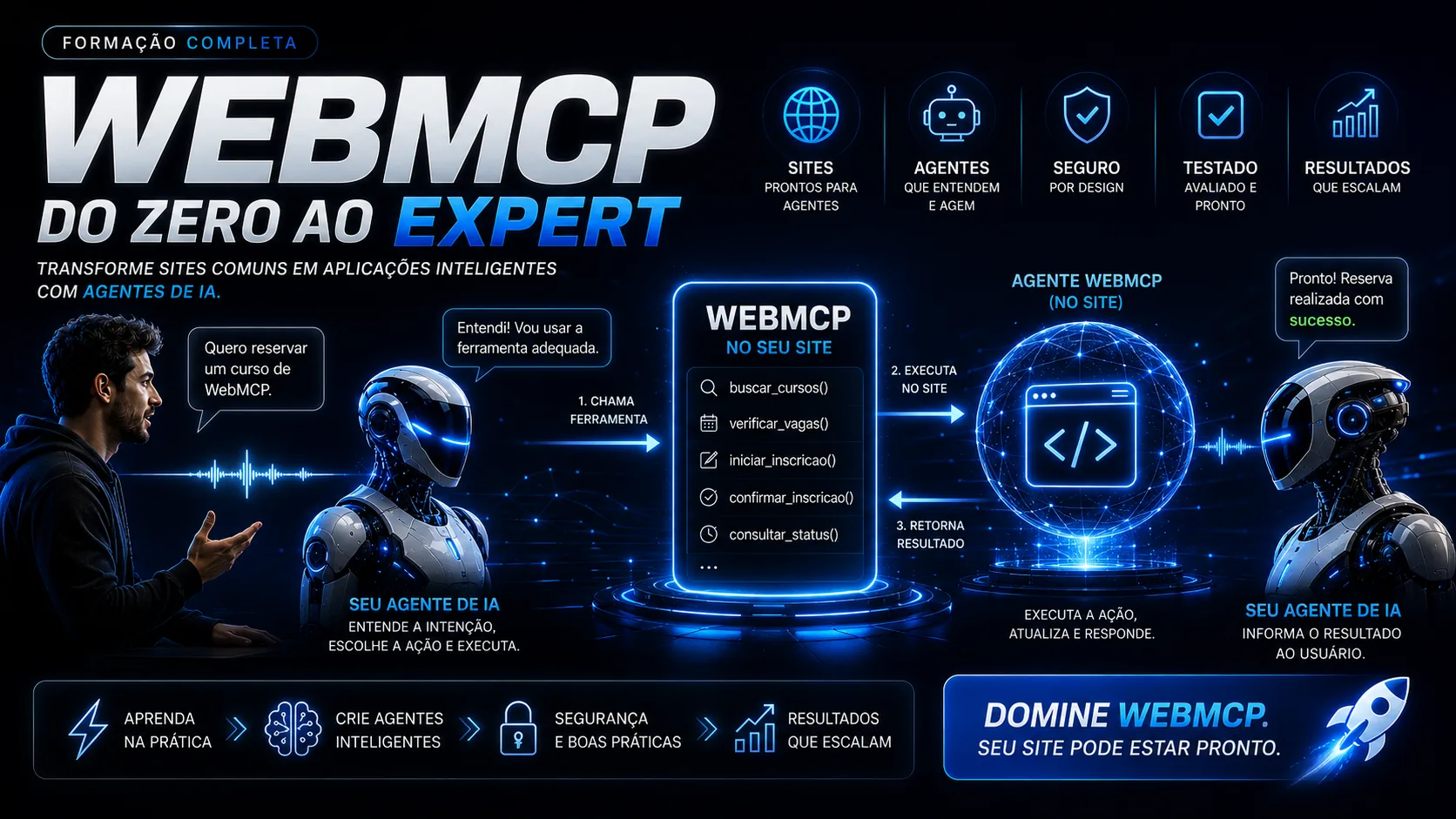
The problem
Agents already open pages, fill in forms, and complete tasks. Without preparation, the site becomes a problem for them and for you.
After the training
Read the scanner's WebMCP, SEO, GEO, and AEO scores and separate observable evidence from what depends on the backend and human review.
Declarative API with toolname and description, and imperative JavaScript tools with JSON Schema, cancellation, and fallback.
Good tools, state, and errors with recovery, migrating existing sites, and integration with modern frameworks.
Discovery, validated execution, cross-origin and permissions, and an observable conversational loop with authorization kept outside the model.
Threat modeling, hybrid WebMCP + backend + MCP architecture, evals, observability, rollout, and governance.
5 courses in order · 16 modules · 96 topics
Each phase has four modules of six topics. Site owners who don't code do the overview and the diagnostic and hand the phases to their team. Those who build continue from Builder to Expert.
Overview
The prerequisites, how the four phases connect, the final project, and the readiness diagnostic for your site.
Building
WebMCP, MCP and the agentic web, development environment, experimental declarative API and imperative API, with a catalog validator.
Integrate
Tool design, state, errors and recovery, migrating existing sites, and modern frameworks without duplicating rules.
Orchestrate
Browser agents that discover and run tools, with cross-origin, permissions, and an observable conversational loop.
Operate
Agent and tool security, WebMCP + backend + MCP, evals and observability, production and governance.
Who it's for
Included in the training
WebMCP Readiness, INEMA's free scanner, gives an overall score, four independent scores, and up to 12 prioritized fixes, with the courses recommended for each gap. It comes together with the projects and videos on the topic.
Why this training
You run the free scan, note the baseline, and join the phase that matches the gap.
Discovery and tools in Builder, contract and state in Integrator, control and permissions in Agent Developer, backend and evals in Expert.
Human confirmation before mutations, real authorization on the backend. The LLM chooses the tool; the site decides whether it runs.
The program shows the limitations of the environment and separates what the scan proves from what requires human review.
Questions
The order is overview → Builder → Integrator → Agent Developer → Expert. Site owners who don't code do the overview and the diagnostic and hand the phases to the team.
For the four phases, yes: they use JavaScript and JSON Schema. The overview and the diagnostic require no code.
It is an experimental technology, currently behind an Origin Trial. The program keeps the limitations visible so you can learn early, at low cost.
Five courses. Each of the four phases has 4 modules of 6 topics: 16 modules and 96 topics in total.
No. WebMCP lives on the page; MCP handles what stays outside the browser. The Expert phase teaches the hybrid architecture without duplicating rules.
Run the diagnostic, review the evidence, and start with the overview already knowing which decisions you need to master.