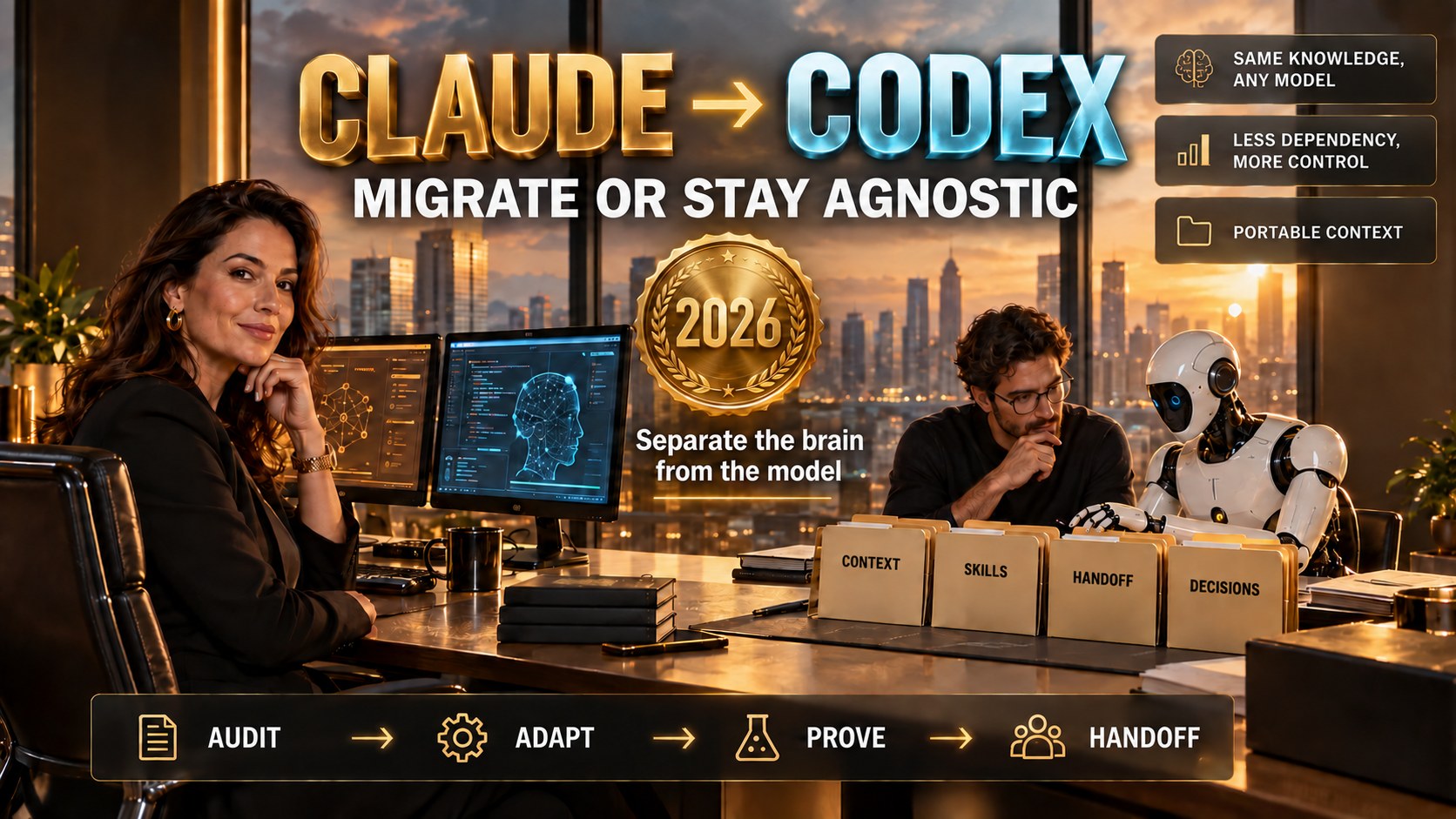
Don't migrate your brain. Separate the brain from the model.
Only CLAUDE.md and AGENTS.md are tied to the provider. Everything else you have built up — context, rules, decisions, tasks, skills, handoffs and memory — is portable Markdown. Once that material lives in a portable layer inside the project, Claude Code, Codex CLI, Gemini or a local model in a container become nothing more than executors: switching models becomes switching an edge, not the center. This area brings together the thesis, the method, the 3-track course, the script kit and the mega-prompts that make it happen in practice.
The course is open and available in English; the kit and the prompts are open and written in Portuguese. The live session has a date to be announced in the community.
01 · What is changing
Lock-in isn't in the model. It's in what you left inside the runtime.
The course starts from a simple discomfort: anyone who has used a coding assistant for a few months has piled up instructions, memory, skills, hooks and thousands of sessions in a format only that runtime reads. When a better, cheaper or mandatory executor shows up, the bill arrives. And it isn't a technical bill: it's knowledge stuck in the wrong place.
Change 1
Lock-in is invisible until switching day
CLAUDE.md, native memory and JSONL sessions look like part of the work. They aren't: they are the storage of the work. The content is durable, the format is disposable — and mixing the two is what stalls a migration.
Change 2
Same knowledge, any model
Rules, accepted decisions, tasks with a definition of done and handoffs are text. Written into files with an owner and a reading order, any agent that reads Markdown picks up where the other one stopped — including a local model running in a container.
Change 3
Less dependency, more control
You stop managing prompts and start managing context, state, tools, processes and validation. The model becomes a reversible choice: if it gets worse, gets pricier or disappears, the center stays in your repository.
It works very well — as long as you only use that one runtime. Switching means rebuilding, and rebuilding means losing the decisions nobody wrote down.
After · the brain in the project
AGENTS.md · context/overview.md · context/decisions/ · tasks/current.md · handoffs/latest.md · skills with a single source
The names are a convention: no runtime loads these folders on its own. What makes them get read is the reading order at the top of AGENTS.md. That's why it works on any executor.
Models change. Your structure stays.
The thesis of the course, in five words.
02 · The method
Audit → Adapt → Prove → Handoff. In that order, and never implementing before auditing.
The kit's mega-prompts start in MODE: audit on purpose: first analyze, plan and simulate; only then implement. The rule that closes the method is the hardest one to accept — a file existing is not proof; the agent having read and used it is.
Diagnose→Audit→Adapt→Install the core→Port skills→Prove→Handoff
Step 1
Audit
What exists today, without touching anything?
A read-only inventory of both runtimes: skills, commands, subagents, hooks and MCP. Each skill is classified as reusable, adapter, native or unresolved.
Step 2
Adapt
What is portable and what is residue?
CLAUDE.md splits in two: portable rules go to AGENTS.md; whatever depends on a plugin, a hook or a Claude menu stays in the specific file, which merely imports the portable part.
Step 3
Prove
Can a fresh session carry on?
Five continuity questions — goal and definition of done, one rule with its source file, the last decision, the next action, conflicts — asked in each runtime.
Step 4
Handoff
What does the next session need to know?
Decisions, open items, next steps and paths in a Markdown file. The following session, in any runtime, reads it before acting. Handoff before closing, always.
What the portable core is
Seven places, each with an owner and an update rule. This is what the kit installs without overwriting anything that already exists in the project.
The files
Where each thing lives
AGENTS.md — stable rules and reading order
context/overview.md — verified facts, with source and date
context/current-state.md — what works and what is pending
context/sources.md — where each piece of information comes from
context/decisions/ — one accepted decision per file
tasks/current.md — goal, owner, definition of done, next action
handoffs/latest.md — the continuation for the next session
The types of information
Owners, not folders
Fact — verified, with origin and date
Preference — how you want it done
Hypothesis — not confirmed yet
Decision — accepted, with scope and status
Provenance beats timestamp: nothing is deleted, you use superseded_by
Indexes can be rebuilt from the sources
Secrets and raw material stay outside the repository
Why this is more than tidiness. Mixing a fact with a hypothesis, or a decision with a preference, is what makes the agent repeat an old mistake and contradict what was already settled. The owner and the date are what let you promote a piece of information from raw memory to approved context — with your approval, never automatically.
03 · Migrate or stay agnostic
Three levels. The first one solves today; the third one solves the next switches too.
The course splits the decision into levels of effort, not into opinions. Migrating means reaching level 1 or 2. Staying agnostic is level 3 — and it is the only one that survives the next model switch, which will happen again.
Level 1 · one click
Import in the app
The shortest path when a ready-made import exists. Fast, and limited to what the other side accepts — the Codex CLI, for example, has no native import.
Level 2 · one command
Migrate with the kit
Run the agente-claude-codex scripts: audit, adapt instructions, install the core, port skills and prove it in a fresh session in both runtimes.
Level 3 · lasting
The portable personal layer
Reorganize the work so that knowledge lives in the project and the runtime is interchangeable. More work once; no migration afterwards.
Migrate now if…
You need to use the other runtime this week, for cost, access or policy reasons.
Your setup is concentrated in a few projects and a few skills.
Most of your skills are plain Markdown (reusable in the audit).
You want results before reorganizing how you work.
Stay agnostic if…
You have already switched tools once and don't want to do it all again.
You want to use two or more executors at the same time, including a local one.
Many skills depend on MCP or on harness hooks (adapter and native).
There is client work, where scope and isolation have to be explicit.
What migrating changesInstructions and skills move to the other runtime. The way you work stays the same.
What staying agnostic changesThe project gains a portable core, a handoff cycle and skills with a single source.
What doesn't changeYou still pick the executor per task. Agnostic doesn't mean abandoning Claude.
The cost of doing nothingKnowledge keeps piling up in a format only one runtime reads.
True for bothAudit before implement, and proof by reading in a fresh session.
There is no final state. Every provider change improves one executor and breaks another: closed models may do without skills that a local model requires, and a hook that exists in one harness doesn't exist in the other. That's why the method ends in maintenance — watching the drift between copies and logging every failure in one line, with the smallest possible fix.
Want to use both together? Once the brain is separated from the model, you can use Claude and Codex on the same project — one does the work, the other reviews it. The Codex + Claude area brings together the six levels of the Use Both kit, who does what and every INEMA course and project on the two tools.
Three tracks: understand, do, and apply it to real projects.
The course Claude → Codex: migrate or stay agnostic is open, with versions in English, Portuguese and Spanish. According to its own curriculum, it has 3 tracks, 18 modules and 108 topics; each module has six topics of about half an hour. Audience: people who already use Claude Code or Codex and want to use both — or not be locked into either.
Track 1 · Fundamentals
Why and what
It defines every term on first appearance: model, runtime, harness, skill, MCP, hook, handoff. This is the track that answers "why isn't copying CLAUDE.md enough".
Also in Portuguese and Spanish. The PT and ES versions are complete mirrors, with their own assets and progress tracked separately per language. Every page has the PT / EN / ES selector at the top.
Command line and Markdown. No interface, no bulk copying, nothing deleted.
The kit is bash plus Markdown files, and it can be used in three ways: the scripts, the mega-prompts (to run the migration by talking to an agent) and the template of the portable core, which you can copy into any project without running a single script.
Steps 0 and 1
doctor.sh and audit.sh
doctor.sh answers "is my environment ready?" — each item comes out as ok, warning or missing, with the command to fix it. audit.sh writes a read-only report with the inventory of both runtimes and the classification of every skill.
Steps 2 and 3
adapt-instructions.sh and init-core.sh
The first one reads the project's CLAUDE.md and writes two proposals next to it, without overwriting. The second copies the portable core, listing what it created and what it kept. There is also faxina.sh, which classifies a long CLAUDE.md section by section.
Step 4
sync-skills.sh with polyskill
One canonical source per skill, copies generated per runtime, and a drift command that tells you, per destination, whether it is identical or has diverged. Installing makes a backup alongside before overwriting.
Step 5
readback-test.sh
It opens a fresh session in each runtime inside the project, asks the five continuity questions and saves the raw answer. Approval is yours, by reading the text: do the answers cite the right files, and does the next action match the task?
Daily cycle
session-handoff and prime
The two canonical skills that ship with the kit: one writes the handoff at the end of the session, the other reads AGENTS.md, context/, tasks/ and handoffs/ before acting and returns a briefing with the sources. Together, they close the cycle.
Maintenance
drift-report.sh and promover-memoria.sh
A weekly report on divergence between the skill copies and the global AGENTS.md; and a flow in which the agent proposes facts with source and date out of raw memory, and only what you approve enters the context.
What has actually been run on this machine (2026-09-13 and 2026-09-16). According to the kit's README: doctor.sh passed with two warnings; the audit found 89 skills existing only in Claude — 71 reusable, 15 adapter, 2 native and 1 without a SKILL.md; adapting the global CLAUDE.md separated 71 portable lines from 7 lines of residue; the core installed in an isolated clone passed the check; readback passed in both runtimes; the canonical skills ended up installed in four destinations with zero drift; and a fresh Codex session, after prime, pointed out three real contradictions between the handoff and the task. These are execution records in the repository itself, not a benchmark and not a measure of model performance.
Would you rather do it by talking? Mega-prompts A (migrate an existing Claude setup) and B (build a portable workspace, with personal and client add-ons) are available as copyable text in the repository. Keep MODE: audit on the first pass, read the plan the agent returns and only then run it in implementation mode.
On the company side. If your question isn't which executor to use, but how to manage agents inside a company — roles, authority levels, cost per result and evaluation —, the AI Management area carries that conversation on.
The best first step is a project of your own, in audit mode.
Pick a project you know well, run the diagnosis and read the audit before changing a single file. In one session you already know what is portable, what needs an adapter and what depends on a hook. The course and the kit are open; the live session about migrating or staying agnostic has a date to be announced in the community.
Course · free and open
Take the course
Three tracks: understand why to separate the brain from the model, run the kit command by command, and apply it to six projects with acceptance criteria.
Fundamentals: vocabulary, three levels, portable core
Where the live session "migrate or stay agnostic" will be announced, with the real system on screen: audit, adapt, prove, handoff. And where you can discuss your own migration with people who have already done theirs.
The date of the live session is announced here first