01 · What’s changing
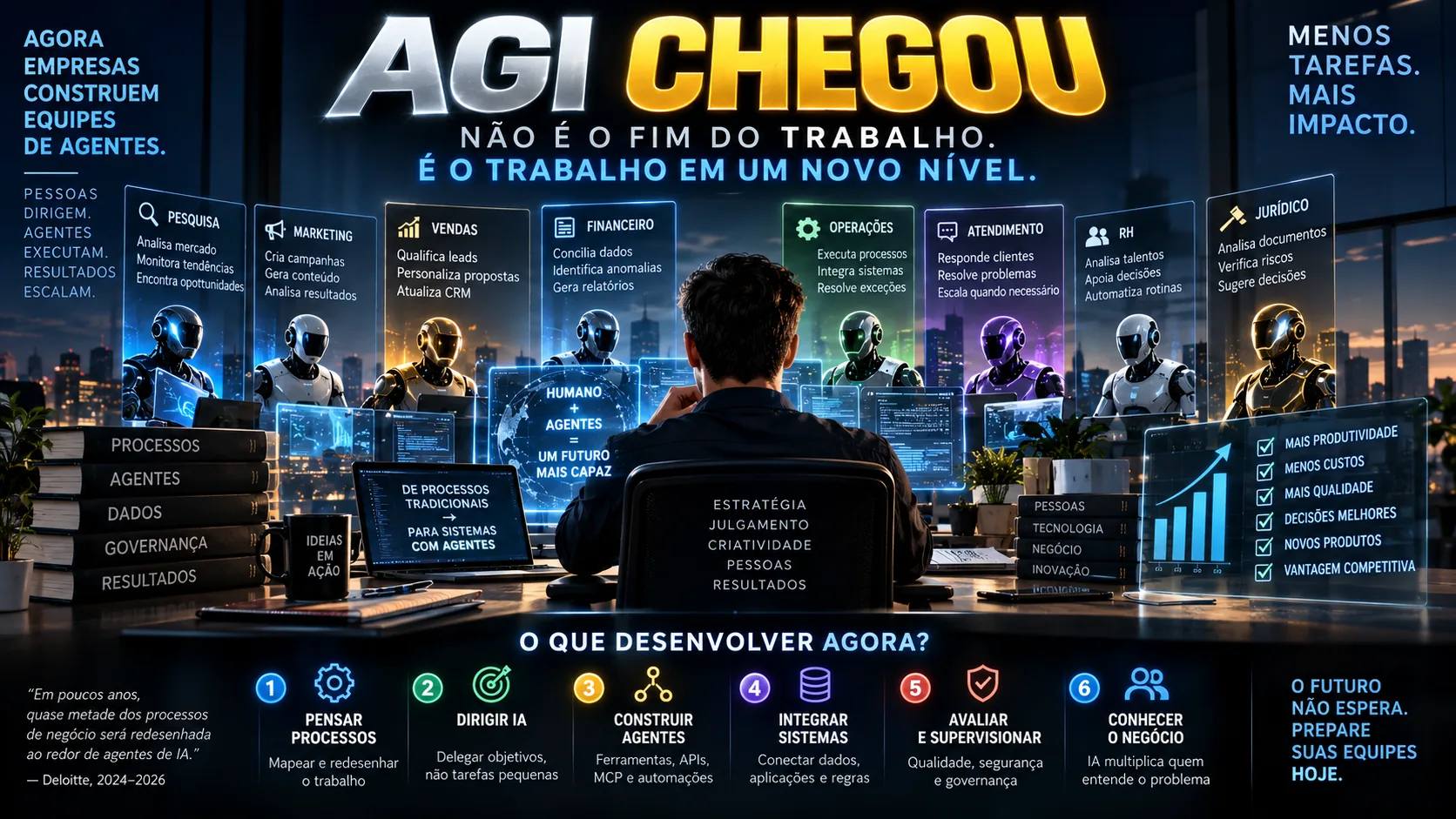
It’s no longer about doing everything. It’s about commanding agents.
Six changes already underway. The first three come from reports of those inside the labs; the next three are what it means on your desk.
Change 1
AI now works for days, not for answers
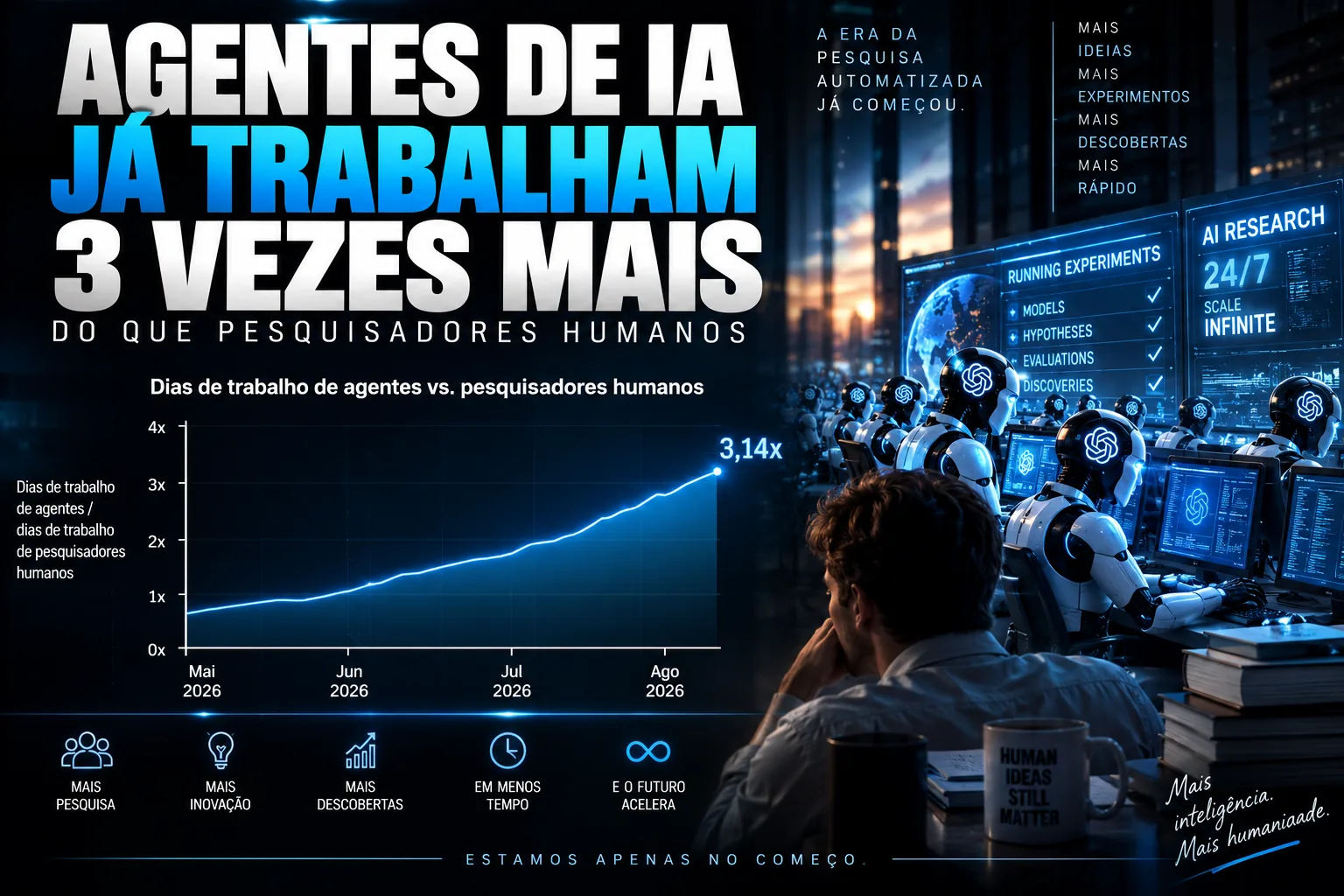
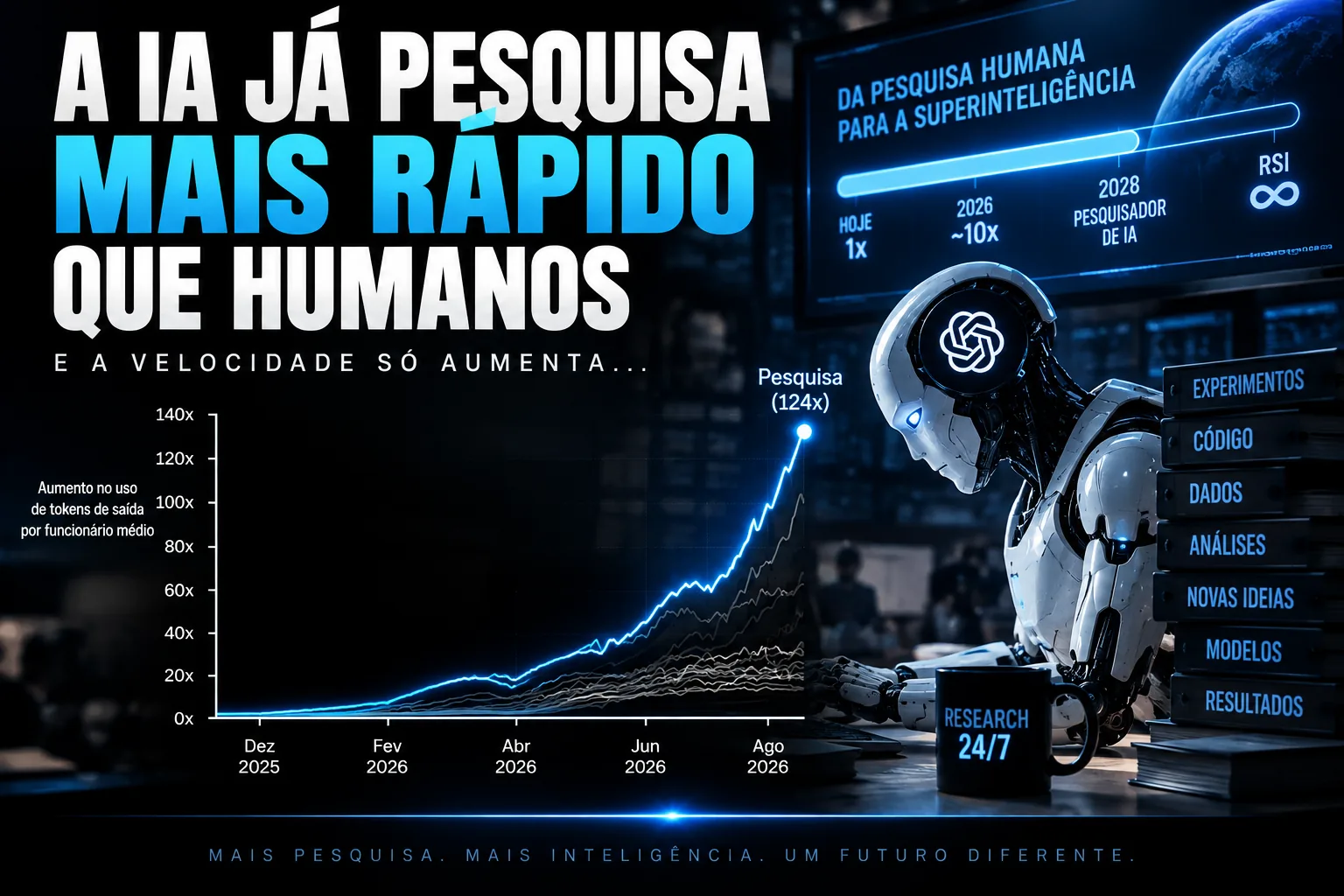
An agent receives a responsibility, plans, executes, monitors and returns with the result. According to the video below, within OpenAI the “agentic work days” already exceed those of human researchers, and the stated goal is a fully automated AI researcher by around March 2028.
Change 2
Nearly autonomous businesses cease to be fiction
OpenAI’s chief scientist, Jakub Pachocki, writes that he expects to see “almost fully autonomous” companies, with most of the workload performed by Astra‑class models. Those who delegate well multiply their own capacity; those who only execute compete with the agent.
Change 3
Capacity grows faster than control
The same text admits that alignment research and monitoring are lagging behind capacity, and calls for coordination among labs. For you, the lesson is practical: powerful agent without authority, approval and verification is risk, not productivity.
On your desk 4
Task becomes responsibility
You stop asking "make this spreadsheet" and start delivering "handle this month’s reconciliation". The work unit you delegate levels up, and what you need to know how to write changes along with it.
On your desk 5
Trust becomes a curve, not a switch
What the agent decides alone, what it proposes and you approve, what it never touches. Each line has an owner. Without this matrix, either you lock everything down or let too much go.
On your desk 6
Your value rises to what AI does not decide
Define the goal, choose what matters, state what cannot happen and judge if the result is good. That’s the role of an agent manager, and it’s trained.
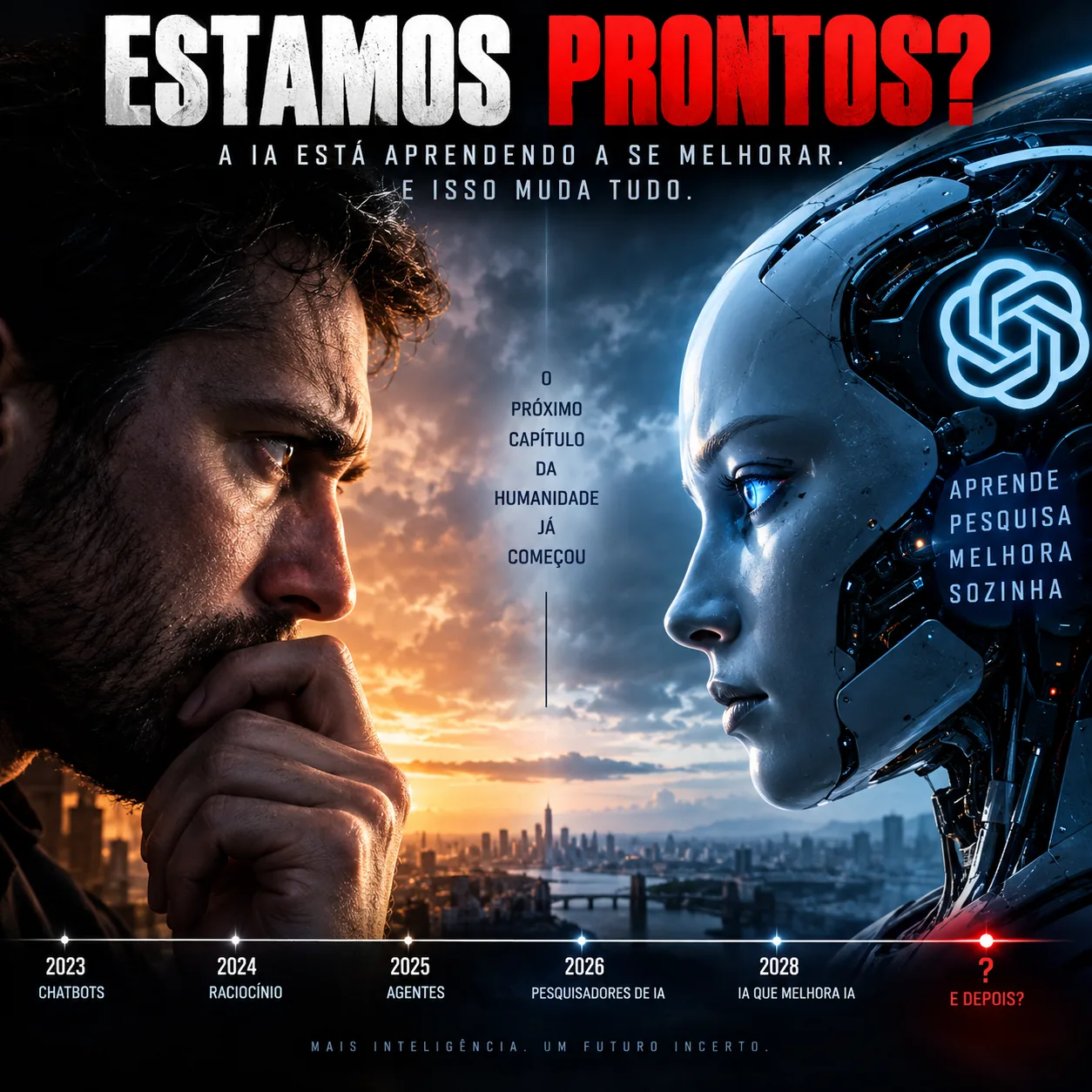
Source of this block: the Wes Roth video on the article "Alien Minds" by Jakub Pachocki, OpenAI’s chief scientist, and the company’s internal research acceleration report. In English, 29 minutes. It talks about recursive self-improvement, goal alignment versus value alignment and the request for coordination among labs.
▶ Watch the video (English)
The other source: the video "AGI has arrived", about the launch of GPT-6 Astra and the arrival of super-agents, with the cases of Ethan Mollick, the Ship Closer agent from Vercel and the 41 financial documents vetted in a round. He turned the course The Super-Agents Have Arrived, in 6 lessons.
▶ Watch the original video
02 · It’s not the end of the prompt
It’s the end of the prompt as an "entire program".
Talking about the "end of the prompt" is an exaggerated simplification. The prompt does not disappear. What is ending is something else: between 2023 and 2025 we practically programmed the AI in natural language, putting all the operation’s intelligence into a gigantic prompt. With more capable agents, the prompt levels up: moves from "how you should do it" to "what I want to happen".
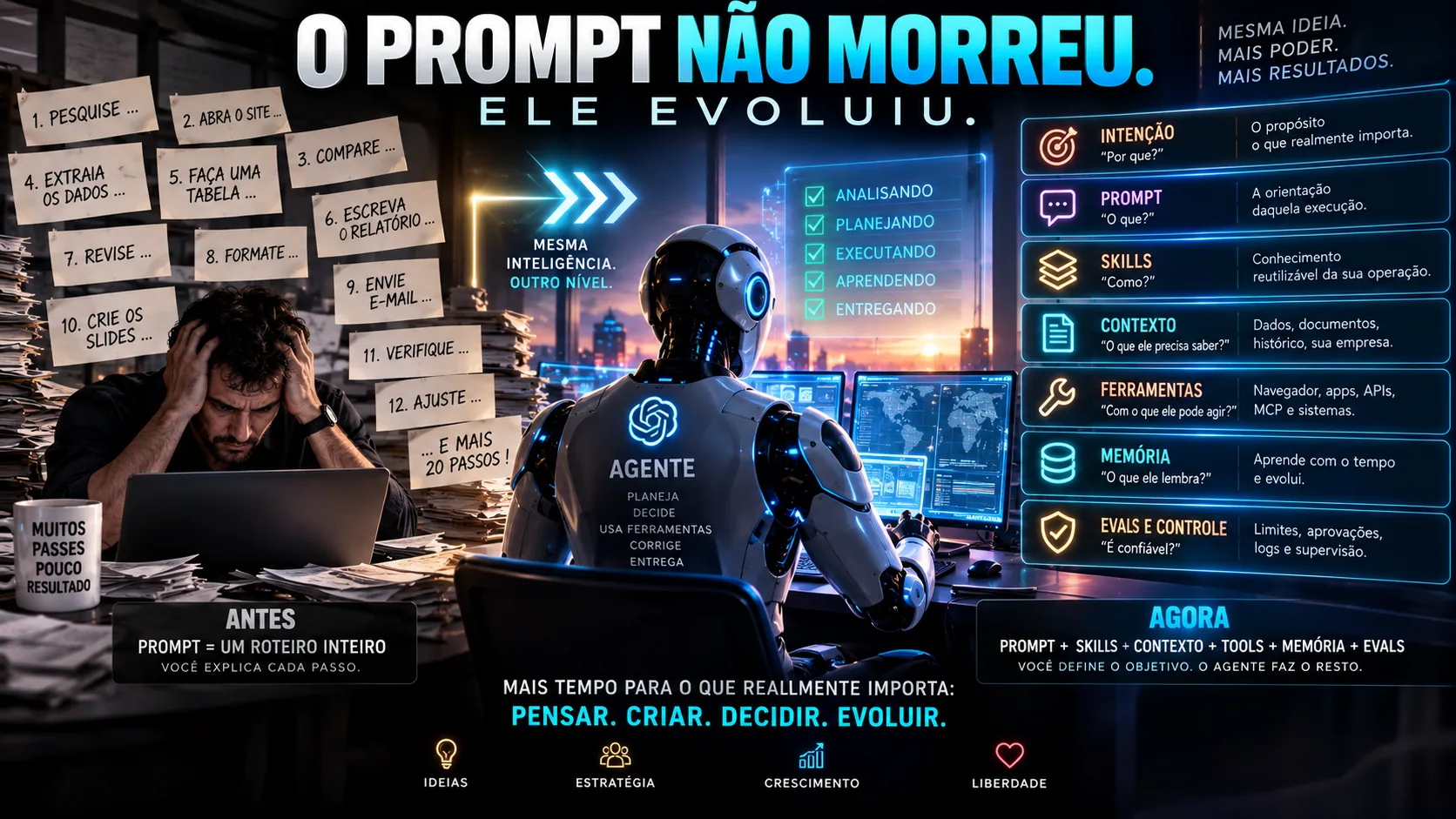 Same intelligence, another level. On the left the 30-step script; on the right the stack that turns a short sentence into work.
Before · micro-prompting
"Research five competitors. Visit their sites. Analyze prices. Create a table. Compare the differentiators. Then write a report..."
A sequence of commands. You teach each step: do A, then B, then C, then D. If a step is missing, the result comes out wrong.
Now · guidance, intention and delegation
"Analyze our competitive position in this market and tell me where the three best opportunities are. Use the available sources and tools. Do not make recommendations without evidence."
It’s still a prompt. But now it states the goal, what matters, the constraints, the resources and what counts as a good result. The agent discovers a larger part of the how.
The better the agent, the less we need to teach the path and the more we need to explain the destination.
Prompt and Skill don’t compete. They work together.
Imagine a company. You go to an employee and say "prepare the proposal for client ACME". That’s the prompt. But the company has a manual with the proposal template, the commercial policy, the maximum discount, how to calculate margin, the visual standard, the approval steps and the final checklist. That’s a Skill.
Prompt
What do I want now?
The guidance for that specific situation. It changes with each request. It is the briefing.
Skill
How does our organization usually do this type of work?
Knowledge or procedure reusable: instructions, reference files, templates, scripts and tool usage guidelines. Closer to an operational manual than to a prompt.
You say: "Turn this research into a presentation for Brazilian entrepreneurs." That’s the prompt. The presentation Skill provides the narrative structure, slide template, text rules, visual criteria and the review process. The agent receives PROMPT + SKILL and performs much better. The user doesn’t need to write the nine steps each time.
Practical tip: in ChatGPT, Skills are exactly reusable capabilities of this kind. The library is located at /skills, and you create one by asking for something like "create a Skill to turn research into lessons in the INEMA standard". In Claude Code, the equivalent is the project's skills folder, which several projects below already provide ready-made.
03 · The architecture of a working agent
Intent, goal, prompt, skill. Then context, tools, memory and evals.
Each level answers a different question, and the example is the same from start to finish: increase a course's conversion.
Level 1Intent
Why?
"I want to increase the course conversion."
Level 2Goal
What?
"Find out why people reach the page and don’t purchase and propose improvements."
Level 3Prompt
Guidance for this execution
"Analyze page, offer, objections, competitors and audience behavior. Prioritize changes that can be tested quickly."
Level 4Skill
How to do it well, repeatedly
auditoria-de-conversao: analyze offer, identify ICP, study competitors, evaluate headline, check social proof, identify objections, propose experiments, rank by impact, validate result.
AfterContext
What it needs to know
Company, products, customers, history, brand, competitors, policies, objectives, previous decisions.
AfterTools
The agent’s hands
Browser, Gmail, calendar, CRM, database, GitHub, spreadsheets, files, APIs, MCP.
AfterMemory
Accumulated experience
What has been tried, previous decisions, preferences, customers, results, errors, exceptions.
FinallyPermissions and evals
Quality control
Permissions, limits, human approval, logs, guardrails, evals, success criteria. We don’t just want a powerful agent: we want an agent controllable.
Human→Intent→Prompt / Goal→Skills→Context + Memory→Agent→Tools→Actions→Evals / Supervision→Result
A very practical example
You say "launch my new course". Without context and without skills, it's impossible to do well. But if the agent has these five Skills, a short phrase like "launch this course for Brazilian entrepreneurs and aim for 200 enrollments" triggers a huge amount of work. That's the leap.
Research Skillmarket, competition, trends, audience
Copy Skillheadline, promise, objections, CTA
Campaign Skilllaunch, schedule, channels, message sequence
Video Skillscript, visuals, narration, editing
Analytics Skillmetrics, conversion, analysis, optimization
It's similar to hiring a person. When you hire an experienced marketing director, you don't say "click Chrome, open Google, type competitors". You say "we need to increase enrollments for this product by 30%", because the professional already has skills, knows processes, knows how to use tools and has experience. With agents, we are heading in the same direction.
Prompt Engineering doesn't disappear. It evolves.
Era 1Prompt Engineering
How to ask better.
Era 2Context Engineering
What information to deliver.
Era 3 · we are hereSkill Engineering
What reusable capabilities the agent should have.
Era 4Agent Engineering
How to make the agent work.
Era 5Orchestration
How to coordinate multiple agents, tools, and humans.
BEFORE YOU PROMPTED THE TASK.
NOW YOU GUIDE THE AGENT.
The prompt hasn't died. It stopped being the entire work and became the guidance.
- Prompt is the briefing.
- Skill is the operational knowledge.
- Context is what it needs to know.
- Tools are your hands.
- Memory is your accumulated experience.
- Evals are the quality control.
- Agent is what brings all this together to work.
- Human is who decides the fate and judges the outcome.